Celina Land Clearing
Celina, TX · Site Prep Specialists
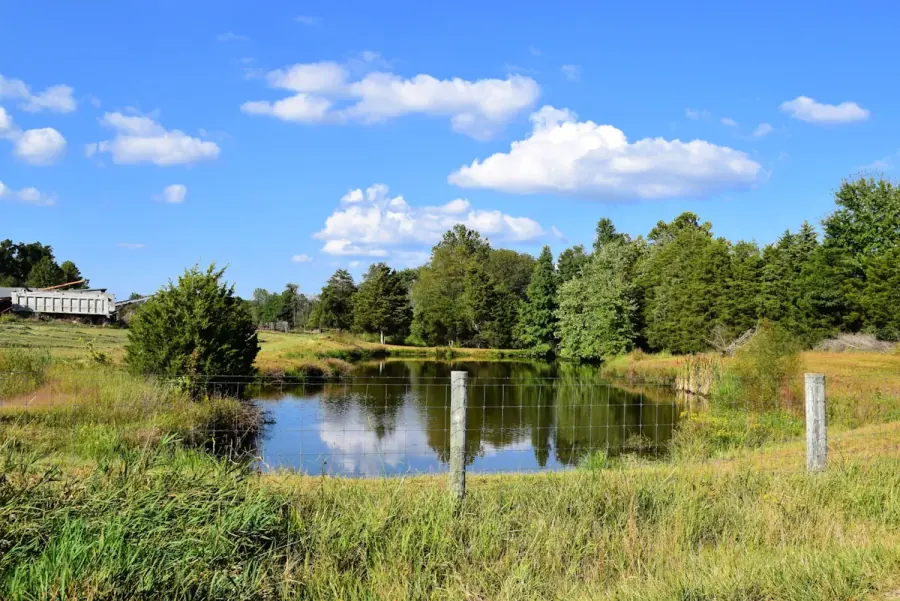
Farm pond holding water in a fenced Collin County TX pasture
Home/Pond Excavation/Collin County TX

Pond Construction in Collin County, TX

Collin County is one of the better places in Texas to build a pond, because Blackland Prairie clay seals a basin without a liner. Stock ponds, fishing ponds, and restoration from $4,000 to $60,000. Free on-site estimates county-wide.

Farm Pond Construction Across Collin County

Collin County is one of the cheapest and most reliable places in Texas to build a pond, and the reason is the dirt rather than the labor market. The county sits on Blackland Prairie, dominated by the Houston Black soil series, which USDA classifies as a fine smectitic thermic Udic Haplustert. In plain terms it is a clay running 40 to 60 percent clay content with the mineralogy that makes the ground crack wide open in August and swell shut after the first real rain. That shrink-swell behavior is exactly what seals a pond basin.

The practical consequence is that most ponds in Celina, Anna, Melissa, Princeton, and Weston hold water on native clay with no bentonite and no liner. On a one acre pond that is a $13,000 to $43,000 line item that never appears on the invoice. Landowners in the Hill Country and East Texas do not get that, and it is worth understanding as an advantage rather than assuming it is normal.

Two exceptions matter. Creek bottoms near Honey Creek, Doe Branch, and the Rowlett Creek tributaries carry layered sand, silt, and gravel lenses that will not hold, and those sites also tend to sit inside mapped floodplain where permitting gets involved. And on the Denton County side of our service area the Aubrey series has a permeable sandy surface horizon over its clay subsoil, so the dam has to be keyed deeper. Test pits on the actual footprint settle both questions during the estimate.

The Four Permit Thresholds

Four separate rules can touch a pond in Collin County, and an ordinary private farm pond clears three of them and only needs the fourth. Knowing which is which is what keeps a simple project from turning into a long approval process.

1
Collin County new-pond permit

Collin County Development Services requires a permit application for new ponds in unincorporated areas, reviewed alongside the property's floodplain status. This is the one that applies to nearly every project. File it before the dirt work is scheduled.

2
TCEQ dam safety, 30 TAC Chapter 299

Attaches at 25 feet of dam height or 50 acre-feet of storage. Almost every private pond is far under both. Local wrinkle: TCEQ's small-dam exemption is unavailable in counties of 350,000 or more residents, and Collin County at roughly 1.19 million is well past that, so the design has to stay under the thresholds on its own merits.

3
Texas Water Code Section 11.142 water right

You may impound up to 200 acre-feet on your own land for domestic and livestock purposes with no water right. The exemption is about use as much as volume, so irrigation, commercial, and industrial storage fall outside it regardless of pond size.

4
Clean Water Act Section 404

Required for excavation or fill in a jurisdictional water of the United States or a wetland, administered by the Fort Worth District of the Corps of Engineers. Section 404(f)(1)(C) exempts farm and stock pond construction, but the 404(f)(2) recapture provision pulls the work back in when it converts a water to a new use and impairs flow. Siting the pond in uplands and off-channel avoids the question.

This is a plain-English summary of how these rules generally apply to private ponds, not legal advice on your parcel. Confirm current requirements with Collin County Development Services, TCEQ, and the USACE Fort Worth District before construction. Our Collin County permit guide covers the floodplain and construction stormwater triggers in more detail.

What Pond Construction Costs Here

Budget $2.50 to $8.00 per cubic yard of material moved, which puts a quarter acre stock pond at $8,000 to $20,000, a half acre at $12,000 to $30,000, and a one acre pond at $25,000 to $60,000. The arithmetic is checkable: one acre is 43,560 square feet, and at 6 feet of average depth that is 43,560 times 6 divided by 27, or roughly 9,680 cubic yards. Multiply by $2.50 to $6.00 and you land on $24,200 to $58,080.

Restoration of an existing silted-in pond runs 40 to 60 percent of the new-build cost, typically $10,000 to $35,000 for a half acre to one acre. Every line item and the full volume table for each pond size is in the pond digging cost guide, and the nine-step build sequence is on the Celina pond excavation page.

Where We Build Ponds

We cover Collin County, the adjacent Denton County corridor, and the Grayson County line to the north. Soil varies across that footprint more than the distance suggests, which is why every estimate starts with test pits rather than a map.

Blackland Prairie clay. Most sites seal naturally. Heaviest pond demand in the county.

Straddles the Collin and Denton line. Soil and permitting both change across town.

Denton County. Aubrey series soil needs the dam keyed into clay subsoil.

Weston

Houston Black clay, large working tracts, strong stock pond and restoration demand.

Anna

Blackland Prairie clay, rapid subdivision pressure on former pasture.

Melissa

Clay soils, mixed ranch and new residential acreage.

Princeton

Eastern Collin County, clay soils, working ag land converting fast.

Van Alstyne

Grayson County line. Ranch acreage, many older tanks needing restoration.

Gunter

North of Celina. Working ranch country with the strongest stock pond demand.

Pilot Point

Denton County. Equestrian acreage, transitional soils, test pits essential.

Pond estimate anywhere in Collin County

We dig test pits, check the watershed and floodplain status, and quote the job flat.

Call Now
Get a Free Acreage Estimate

No obligation. We'll be in touch soon.

Ready to Build a Pond in Collin County?

Free on-site evaluation. We find the clay, check the watershed, and quote it flat.

Pond Construction Collin County TX: Frequently Asked Questions

Do I need a permit to build a pond in Collin County?
Yes. Collin County Development Services requires a permit application for new ponds in unincorporated areas, reviewed alongside the property's floodplain status, and that application applies to essentially every private pond project. Three additional thresholds sit above it and rarely bind: TCEQ dam safety under 30 TAC Chapter 299 at 25 feet of dam height or 50 acre-feet of storage, a TCEQ water right for impoundments above 200 acre-feet or for uses beyond domestic and livestock, and a Section 404 permit from the Corps of Engineers for excavation in a jurisdictional water or wetland. Property inside a city's limits or ETJ may also face municipal review.
What size pond can I build without a permit in Texas?
A pond with a dam under 25 feet tall holding under 50 acre-feet, built in uplands rather than a flowing creek, and used for domestic or livestock purposes stays clear of state and federal permitting. Fifty acre-feet is roughly a 6 acre pond at 8 feet average depth, so nearly every private pond is far under it. One local point most pond pages omit: TCEQ's small-dam exemption is unavailable in counties with a population of 350,000 or more, and Collin County at roughly 1.19 million and Denton County at roughly 1 million both clear that line by a wide margin. Landowners here cannot rely on the exemption, so the design has to stay under the height and storage thresholds on its own. The county permit application is separate and applies regardless of size.
Will a pond hold water in Collin County?
In most of Collin County, yes, without any liner or bentonite at all. The county sits on Blackland Prairie dominated by the Houston Black soil series, a fine smectitic thermic Udic Haplustert running 40 to 60 percent clay content. Smectitic mineralogy is what makes Collin County ground crack wide open in August and swell tight after a rain, and that same shrink-swell behavior is an excellent natural pond seal. Celina, Anna, Melissa, Princeton, and Weston sites typically hold water on native clay alone. The exception is creek bottoms with layered sand and gravel lenses, and the Denton County side of the service area where the Aubrey series has a permeable sandy surface horizon.
How much does pond construction cost in Collin County?
Pond construction in Collin County costs $2.50 to $8.00 per cubic yard of material moved, which is $4,000 to $15,000 for a small ornamental pond, $8,000 to $20,000 for a quarter acre stock pond, $12,000 to $30,000 for a half acre, and $25,000 to $60,000 for one acre dug 8 to 10 feet deep. Collin County is one of the cheaper places in Texas to build a pond, and the reason is soil rather than labor rates: native clay that seals on its own removes a bentonite or liner line item worth $13,000 to $43,000 on a one acre basin. Our cost guide shows the cubic yard math for every common size.
What is the best size for a farm pond in North Texas?
A half acre to one acre with 8 to 12 feet at the deep end is the sweet spot for a working farm pond in Collin County, and it is what we build most often. Below a quarter acre a pond draws down hard in a dry Texas summer and struggles to hold fish through it. Above two acres the cost curve is still favorable per acre but the dam gets tall enough that design and the TCEQ thresholds need real attention. A one acre pond at 6 feet average depth holds roughly 6 acre-feet, which is ample livestock water and a genuinely fishable body of water, for about 9,680 cubic yards of dirt.
Is it legal to build a pond on your property in Texas?
Yes, Texas law is comparatively permissive about private ponds. Texas Water Code Section 11.142 lets a landowner build a reservoir on their own property impounding up to 200 acre-feet for domestic and livestock purposes with no water right permit from TCEQ, which is far more than any normal farm pond holds. The limits are about use and location rather than ownership: impounding primarily for irrigation, commercial, or industrial purposes needs a permit regardless of size, damming a flowing creek raises Clean Water Act Section 404 questions, and building in a FEMA-mapped floodplain requires a floodplain development permit. The county pond permit application applies on top of all of it.
How much does it cost to clean out an existing pond in Collin County?
Restoring a silted-in pond typically runs 40 to 60 percent of what the same pond would cost new, so $10,000 to $35,000 for a half acre to one acre pond in this area. Most of the tanks on Collin County ranch land were pushed up decades ago and have been accumulating sediment ever since, which is why restoration is a large share of our pond work. The job means draining, excavating the sediment, reshaping the basin, keying the dam back into clay, and repairing or resizing the spillway. It usually beats building new, because site selection is already proven and the watershed is known. The unknown is the dam's condition, which only shows with the water down.
How long does a new pond take to fill in Collin County?
A new Collin County pond usually reaches full pool over one to two wet seasons, so anywhere from a few months to about two years depending on timing and rainfall. February through May is the reliable rain window here, so a pond finished in late summer or fall often fills over a single winter and spring. One finished in June may sit low until the following spring. Watershed size is the other driver: a pond sited in a natural draw collecting runoff from 15 or 20 acres fills far faster than one on a flat site catching only its own footprint, which is a reason to get siting right at the start.
Call Now
Free acreage estimate
Contact