How to Hire a Land Clearing Contractor in Celina, TX
Texas does not license land clearing contractors, so vetting is entirely on you. Here is how to check insurance, registration, equipment, and scope before you hand anyone the keys to your acreage, plus the red flags that predict a bad job.
How to Find and Hire a Land Clearing Contractor in Celina, TX
To hire a land clearing contractor in Celina, verify general liability insurance directly with the carrier, confirm the business is registered with the Texas Secretary of State, check that they own the mulching and grubbing equipment they plan to use, call three Collin County references, and require a written itemized scope before any machine arrives. Texas issues no license for this trade, so those five checks are the only filter between you and whoever answered the phone.
That absence of licensing is the single most important thing to understand before you start collecting bids. Plumbers, electricians, and HVAC contractors in Texas are regulated by the Texas Department of Licensing and Regulation and the relevant state boards. Land clearing, tree removal, and forestry mulching are not. There is no state exam, no bond requirement, and no registry you can search to see whether a clearing contractor has ever had a complaint. A person can buy a used skid steer on Saturday and advertise as a Celina land clearing contractor on Sunday, and nothing about that is illegal.
In a normal market that would be a minor problem. In Celina it is not a normal market. The US Census Bureau named Celina the fastest-growing city in the country for the year ending July 2025, with 24.6% growth to 64,427 residents. Fast-growing markets attract out-of-area operators chasing the work, and the ones who show up without local experience are learning blackland clay on your parcel. If you want the service-side detail on what the work involves, start with our main land clearing in Celina, TX page, then come back here for the hiring side.
Land Clearing Contractor, Tree Service, or Excavator: Who Do You Actually Hire?
Hire a land clearing contractor when the work is measured in acres, and a tree service when the work is measured in trees. That single rule resolves most of the confusion, and hiring the wrong one is the most expensive early mistake landowners make in Collin County.
Tree services are built around removing individual trees, usually near structures, using climbers, bucket trucks, and sometimes a crane. Their pricing is per tree and it reflects the risk of dropping timber next to a roof. Put a tree service on five acres of cedar and the invoice becomes absurd, because they are pricing three hundred separate removals.
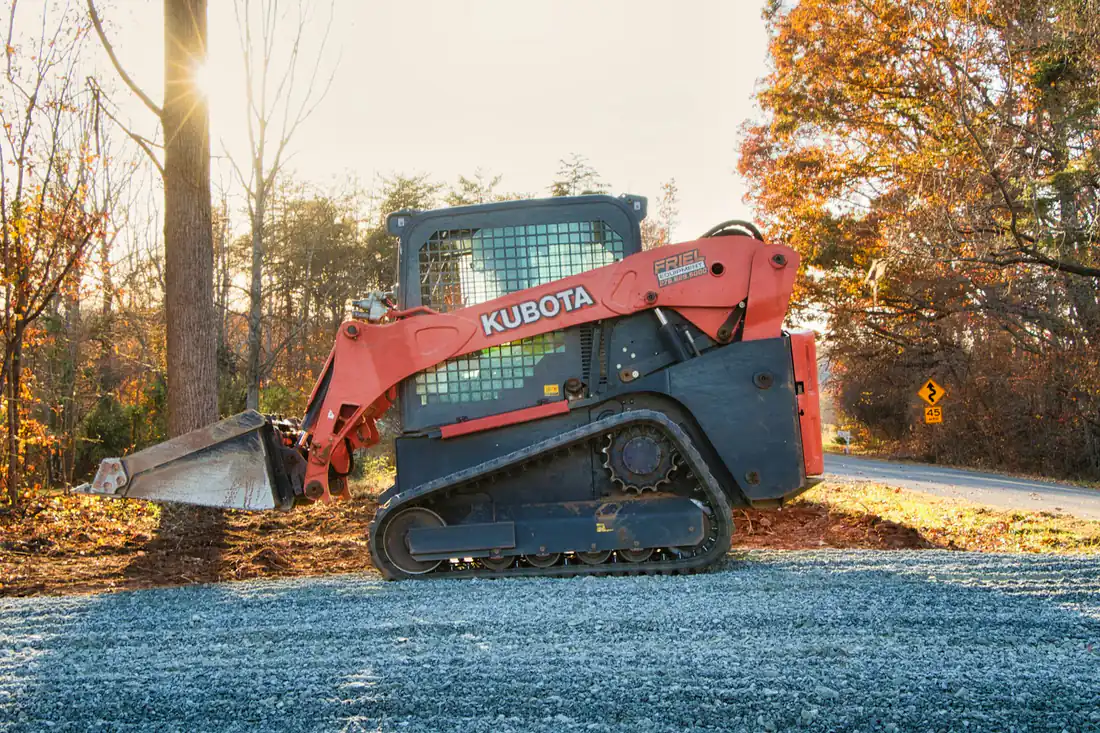
Land clearing contractors price by the acre and by machine hour. They run forestry mulchers, compact track loaders, and excavators with grubbing attachments, and the entire operation is designed to process vegetation in volume and leave ground a builder can use. For a pasture, a fence line, a building pad, or raw acreage, this is the right trade and it is cheaper per acre by a wide margin.
Excavation and site work contractors occupy the middle. Many can clear, but plenty subcontract the mulching to a specialist and mark it up. That is not automatically bad, but you should know whether the company you are paying is the company operating the machine, because the reference checks and insurance verification need to follow the crew that actually shows up.
How to Vet a Land Clearing Contractor: 6 Checks Before You Sign
These six checks take about two days of calendar time and almost no effort, and they eliminate the overwhelming majority of bad outcomes in this trade. Run all six on every contractor you are seriously considering, not just the cheap one.
- 1
Get the certificate of insurance directly from the carrier
Ask for a certificate of insurance listing general liability and, if the contractor has employees, Texas workers compensation. Do not accept a PDF forwarded from the contractor's phone. Ask them to have the agent email it to you, or call the agent number printed on the certificate and confirm the policy is active today. A lapsed policy still prints a beautiful certificate. For land clearing on an occupied or adjacent-to-occupied parcel, $1,000,000 general liability is the working floor in Collin County, because one thrown cedar limb through a neighbor's window costs more than most clearing jobs.
- 2
Confirm the business is actually registered in Texas
Texas does not license land clearing contractors, so business registration is the only public paper trail you get. Look the company up in the Texas Secretary of State business search and the Texas Comptroller taxable entity search. An LLC in good standing with a filing date that matches how long they claim to have been working tells you the operation is real. A company that cannot be found in either database is operating as an unregistered sole proprietor, which is legal but leaves you with nobody to pursue if the job goes wrong.
- 3
Verify they own the equipment rather than renting it per job
Ask what machines they will bring and whether those machines are owned or rented. Owned iron matters on a Celina job for two reasons: a contractor who rents by the day is on the clock in a way that rewards speed over care, and a rented mulcher head is frequently the wrong class for dense eastern red cedar. You want to hear specific model classes, not the word equipment. A crew that runs a compact track loader with a drum mulcher plus an excavator for grubbing can actually pull cedar at the root. A crew with a bucket and a chainsaw is going to cut stumps and leave you re-sprouts.
- 4
Ask for three local references on blackland clay
References only mean something when the soil matches. A crew with a flawless record clearing sandy East Texas pine has never dealt with what Collin County clay does to a track machine after two inches of rain. Ask for three jobs inside Collin or Denton County in the last twelve months, then call at least one and ask the single most useful question: did the site drain the way you expected after they left. Rutting and ponding are the failures that show up two months later, long after the invoice is paid.
- 5
Require a written itemized scope before any work starts
The estimate should separate clearing, stump treatment, debris handling, grading, and mobilization into their own lines, and it should state the clearing boundary in a way a stranger could walk. Vague scopes are where disputes come from. If the paper says clear the lot, the contractor decides what the lot means, and in practice that means the easy two thirds get cleared and the back fence line does not. Lines that should always be explicit: stump grinding to grade versus extraction below grade, whether material is mulched on site or hauled off, and who pays the dump fees.
- 6
Settle who is responsible for permits and stormwater compliance
Before signing, get in writing who pulls permits and who files stormwater paperwork. In Celina city limits, tree removal on protected caliper trees can require a permit. Anywhere in the state, a clearing job that disturbs one acre or more triggers a TCEQ Construction General Permit and a stormwater pollution prevention plan. Parcels near Honey Creek and other FEMA-mapped floodplains may need a floodplain development permit. A contractor who has worked Collin County will answer this without hesitating. One who says permits are not needed for clearing is telling you how many acres they have actually done here.
8 Red Flags That Predict a Bad Land Clearing Job
Every one of these shows up before work starts, which is the useful part. None of them require you to be an expert in clearing. They only require you to notice what a legitimate operation does as a matter of course and what an improvised one skips.
Unmarked truck and no company signage
A legitimate clearing outfit has its name on the equipment trailer because that trailer is a billboard parked on a job site in the fastest-growing city in America. No markings usually means no registered entity, no commercial auto policy, and nobody to find in six months.
Verbal quote only, no written estimate
A number spoken while standing in a pasture is not a scope. Without a written itemized estimate you have no defense against the two most common disputes in this trade: stumps that were ground instead of extracted, and a back acre that never got touched.
Cash only, or a large deposit demanded up front
Cash only means no paper trail for you and frequently no tax registration for them. A deposit to cover mobilization and fuel is normal on a rural job. A demand for half the total before a machine arrives is the single most reliable predictor of a crew that disappears.
Cannot produce a certificate of insurance on request
Every insured contractor can get a COI emailed from their agent within an hour. Delay, excuses, or a screenshot of an expired policy all point the same direction. On an uninsured job, damage to a neighbor's fence, a buried gas line, or an injured operator can land on the landowner.
Price far below every other bid
Clearing has hard costs that do not compress: fuel, machine hours, cutter teeth, and transport. A bid at half the field usually means stumps are not included, debris is being left in a pile for you to deal with, or the crew intends to burn material during a Collin County burn ban.
Pressure to start tomorrow before you have permits sorted
Real clearing crews in Celina are booked two to four weeks out from September through February. An operator with instant availability during peak season and urgency about starting before paperwork clears is managing your hesitation, not their schedule.
No plan for the debris
Ask where the material goes and listen for a specific answer: mulched on site, hauled to a named facility, or chipped and sold. Vague answers end with a burn pile that violates a burn ban, or a debris windrow along your fence line that the next contractor charges you to remove.
Will not put the clearing boundary on paper or on the ground
The boundary should be flagged before work starts and described in the estimate. Crews that skip this step tend to clear to whatever line is convenient for the machine, which on a rural Celina parcel can mean taking out specimen hardwoods you intended to keep.
Licensing and Permit Requirements for Land Clearing in Celina, TX
There is no Texas state license for land clearing contractors, and there is no Celina city license for them either. What Celina and Collin County do regulate is the project: tree removal on protected trees, stormwater discharge once disturbance reaches one acre, and development inside mapped floodplains. Those are permits attached to your land, not credentials attached to the contractor, and confusing the two is how landowners end up with a fine on a job they thought was fully covered.
City tree preservation inside Celina limits
If your parcel is inside Celina city limits, tree removal above a certain trunk caliper can require a permit and, in some cases, mitigation plantings or a fee in lieu. Protected species and caliper thresholds are set by city ordinance and they change, so the current requirement should be confirmed with the City of Celina development services department before clearing starts, not after. Parcels in the extraterritorial jurisdiction and in unincorporated Collin County generally face lighter tree regulation, which is why two neighboring properties can have completely different paperwork.
TCEQ stormwater once you disturb one acre
Clearing that disturbs one acre or more, or that is part of a larger common plan of development reaching one acre, requires coverage under the TCEQ Construction General Permit along with a stormwater pollution prevention plan. In practice that means filing a notice of intent, posting a site notice, installing and maintaining erosion controls, and stabilizing disturbed soil before you close out. The TCEQ construction stormwater program publishes the current thresholds and forms. A contractor who has not heard of a SWPPP is a contractor who has never run a job at that scale here.
Floodplain development near mapped creeks
Parcels touching Honey Creek and other FEMA-mapped floodplains may need a floodplain development permit from the city or county floodplain administrator before ground is disturbed. You can check whether your parcel intersects a mapped flood zone on the FEMA Flood Map Service Center before you start taking bids, which is worth doing because it changes both the permitting and the price. Our Collin County land clearing permit guide walks the full decision tree parcel by parcel.
Insurance is the check the state does not run for you
Because no license exists, insurance verification carries the weight that licensing carries in other trades. Texas is also unusual in not requiring most private employers to carry workers compensation, so an uninsured crew injured on your acreage can become your problem. Ask for general liability at $1,000,000 per occurrence, commercial auto, and workers compensation if the crew has employees. Then verify the certificate with the agent listed on it rather than with the contractor who sent it.
8 Questions to Ask Before Hiring a Land Clearing Contractor
Ask these during the walkthrough, while you are both standing on the property and the answers can be pointed at. The answers you want are specific. Vague answers on a rural Celina parcel almost always become change orders later.
What machines are you bringing and do you own them?
What a good answer sounds likeYou want a named machine class, not a category. Drum mulcher on a compact track loader plus an excavator for grubbing is the honest answer for cedar work.
Are stumps ground to grade or extracted below grade, and which does my plan need?
What a good answer sounds likeGrinding is fine for pasture. Anything carrying a slab, driveway, or pavement needs extraction below grade. A contractor who does not ask what you are building has not priced the job correctly.
Is the debris mulched on site or hauled off, and who pays the dump fees?
What a good answer sounds likeHaul-off can add $2,000 to $5,000 on a five acre tract. If it is not a separate line on the estimate, it is a dispute waiting to happen.
How many acres will this job disturb in total?
What a good answer sounds likeOne acre is the TCEQ threshold. If the answer is close to an acre, ask directly whether a Construction General Permit and stormwater plan are being filed and by whom.
What happens if it rains for three days mid-job?
What a good answer sounds likeOn Collin County blackland clay this is not hypothetical. You want to hear that work stops, machines come off the wet subgrade, and the crew returns rather than pushing through and rutting the pad your builder has to fix.
Will you leave the site stabilized?
What a good answer sounds likeBare clay erodes in a single North Texas thunderstorm. Seeding, mulch or straw on slopes, and silt fence at discharge points should be named in the scope, not assumed.
Can you give me three Collin County references from the last year?
What a good answer sounds likeLocal references on matching soil. A refusal, or references exclusively from outside North Texas, tells you what you need to know.
Who is my point of contact while the machines are running?
What a good answer sounds likeOn a multi-day clearing job you want one name and one number. Crews that route everything through a dispatcher in another city are the ones that miss the fence line you flagged.
Why a Local Crew Beats a Regional Franchise on Collin County Clay
A local Celina clearing crew beats a regional or franchise operation primarily because of soil. Collin County sits on expansive blackland Vertisol clay, a soil that shrinks and cracks open in drought and turns slick and load-sensitive within hours of rain. Operators who work this ground every week know when to pull machines off a wet subgrade. Operators rotating through from sandier markets do not, and the cost of that education lands on your building pad.
The practical failure looks like this. A tracked machine works a saturated blackland lot, the tracks pump the clay, and the subgrade under the future slab is churned to a depth that has to be undercut and replaced before the foundation can go in. The clearing invoice looked competitive. The remediation invoice does not. This is the single most common way a cheap clearing bid becomes an expensive one in Collin County, and it is entirely a function of operator judgment about when to stop.
Local crews also read the vegetation correctly. Eastern red cedar is the dominant invasive on transitional ranch land here and it has to be extracted at the root, because a cedar or mesquite cut at the stump re-sprouts and you pay twice. Crews whose experience is East Texas pine or Hill Country limestone default to different techniques, and those techniques leave you with a field of re-sprouting stumps two seasons later.
Then there is accountability. A local outfit in a town growing 24.6% a year is one conversation away from every builder and GC in the market. That reputational exposure is a stronger guarantee than any contract clause, because the contractor who leaves a rutted pad in Celina finds out within a month what that costs them. A crew working three hundred miles from home has no such constraint.
Hire the crew that can name the soil, name the machine, name three jobs within twenty miles, and put all of it on one page of paper. In a trade the state does not license, that is what credentials look like. We clear Celina, Prosper, Anna, and Melissa every week, and we will hand you the itemized scope before we ask for anything.
Want a Written, Itemized Clearing Estimate?
Free on-site walkthrough in Celina and across Collin County. Insurance certificate provided on request, every time.