House Pad Prep in Celina, TX
Building pads for new homes, shops and barndominiums, built in compacted lifts on Celina's expansive clay. Most North Texas pads run $2,500 to $15,000 or more.
House Pad Prep for Celina Homesites
House pad prep in Celina is the dirt work between a cleared lot and a poured slab: the topsoil and roots come off the footprint, the native clay is reworked at the right moisture, fill goes on in thin compacted layers up to the elevation on the plans, and the pad is shaped so water runs away from it. Celina Land Clearing handles that work, from a single house pad to a shop, barn or barndominium pad.
The reason it gets its own page is the ground. Much of Celina sits on Houston Black clay, a Blackland Prairie soil with smectite clay that cracks wide when dry and swells when wet. A slab poured on that clay without the right pad underneath can move with every wet and dry season, which is why the engineer's soil report, not the dirt contractor, sets the recipe below. On acreage outside city sewer, the pad usually shares a visit with clearing for the septic system.
What House Pad Prep Includes
- Clearing and grubbing the footprint, including every stump and large root under the slab. If the lot still has trees, that is lot clearing first.
- Stripping topsoil and organic material off the pad area, stockpiled for the yard later.
- Conditioning the native clay: scarified and compacted at or above its optimum moisture so it does not start the job dry.
- Placing fill in lifts, each one watered, compacted and, where the engineer requires it, density tested before the next goes on.
- Shaping and rough grade: pad edges sloped, the lot graded to drain, and the driveway grading tied in.
House Pad Cost in Celina
A house pad in the Celina area usually costs $2,500 to $15,000 or more, and North Texas builders budget about $4,500 to $12,000 for pad site grading and fill on a typical homesite. The spread comes down to fill volume. A 60 by 40 foot pad raised 2 feet holds about 178 cubic yards of compacted fill (2,400 square feet times 2 feet, divided by 27), and loose dirt has to be hauled in beyond that because it shrinks as it is compacted. Every extra foot of height on a low lot adds roughly the same volume again.
The other cost drivers are whether select fill must be imported rather than reworking site clay, how far the trucks travel, whether the engineer requires lift-by-lift density tests, and how much clearing is left to do. Clearing and pad work priced together is usually cheaper than two mobilizations; the Celina land clearing cost guide covers the clearing side.
Price sources: GradeWerx building pads (DFW); Hedgefield Homes, North Texas site development costs. The cubic yard figure is our own arithmetic.
How a Pad Is Built on Expansive Clay
A pad on Celina clay is built to keep moisture steady under the slab, not just to be hard. A geotechnical report for a project in Northlake, Denton County, shows the typical North Texas recipe: the site clays tested at plasticity indexes of 14 to 39, the report warned that a slab can heave considerably on dry expansive clay, and it called for at least 1 foot of non-expansive select fill over moisture conditioned clay to hold movement to about an inch. Over-compacting the clay was ruled out, because dense dry clay swells the most when it finally gets wet.
| Layer or check | Typical spec | Why it matters |
|---|---|---|
| Native clay under the pad | Moisture conditioned (worked wetter than optimum), not over-compacted | Dry Blackland clay swells when it gets wet under a slab |
| Select fill layer | Sandy clay or clayey sand, liquid limit under 35, PI about 5 to 16 | Low plasticity fill moves far less than the native clay |
| Lift thickness | Loose lifts of about 8 to 9 inches | Thin lifts compact all the way through |
| Compaction | At least 95% of standard Proctor (ASTM D698), near optimum moisture | The number the density test checks, lift by lift |
| Pad height | Finished pad 18 inches above surrounding ground on county plans; floor 2 ft above the base flood elevation near floodplains | Collin County drainage standards |
Specs from CMJ Engineering report 1247-23-03 (Town of Northlake) and the Collin County Drainage Design Standards. Your own soil report governs your pad.
West of Celina toward Aubrey and Pilot Point the ground changes to sandy loams over clay subsoil, which drain better at the surface but still need the clay layer checked. Either way, ask the contractor to build to the soil report and to schedule the density tests the engineer lists, so a failed lift is caught before the next one buries it.
Pad Height, Drainage and Permits
Pad height in Collin County is set by drainage, and the county's design standards spell it out for subdivision plans: finished pad or floor elevations at least 18 inches above the surrounding ground, and minimum finished floors 2 feet above the fully developed base flood elevation wherever a lot sits next to a 100-year floodplain, pond or creek. A homesite inside Celina follows the city's approved grading plan, and the city's earthwork permit applies to any land disturbance of 0.1 acre or more, which every house pad is. Outside city limits, see the Collin County permit guide.
Barndominiums, shops and metal buildings follow the same rules with bigger numbers. The pad is sized from the building manufacturer's slab drawing, the larger footprint multiplies the fill volume, and a shop pad often shares the lot with a long drive and a driveway culvert at the road ditch.
Real work from our featured contractor
Recent project from our featured contractor
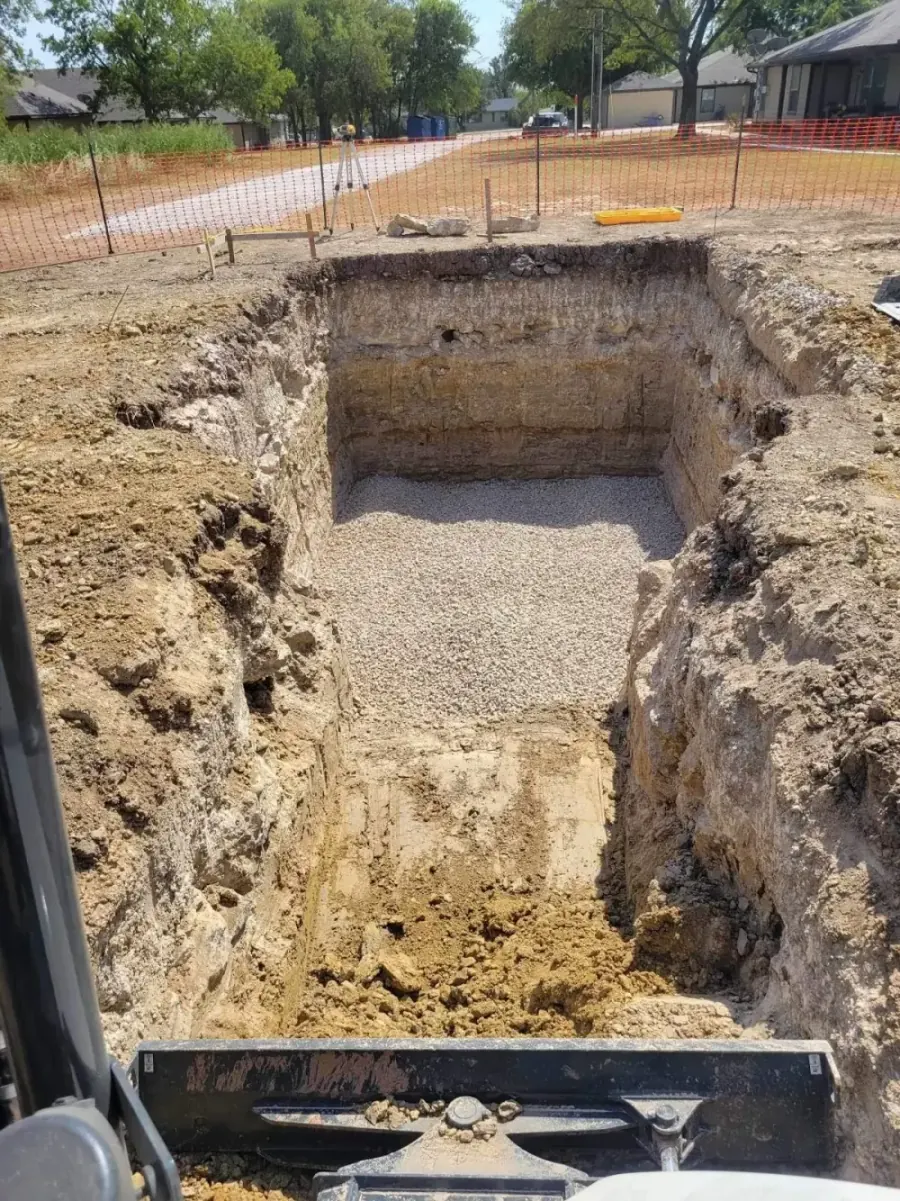
From our featured contractor's own job photos: a deep rectangular excavation with straight, clean walls and a layer of gravel on the floor, fenced off with orange safety fencing.
Melody C. wrote: “[Our featured contractor] did an absolutely fantastic job on the grade work and pad for our new build.”
Send the footprint size and your soil report if you have one. Free on-site estimate.
Call NowHouse Pad Prep Celina TX: Frequently Asked Questions
How much does a house pad cost in Celina TX?
What is select fill and do I need it for my pad?
How high should a house pad be in Collin County?
Can a house pad be built from the dirt on my lot?
How long should a new pad sit before the slab is poured?
Is a barndominium or shop pad different from a house pad?
Last reviewed October 2026.